Driving Business Value, Customer Experience, and Security Through Customer Identity and Access Management (CIAM) Modernization
Business and Customer Value First Perspective
CIAM modernization is often positioned as a security initiative. While security is an important outcome, forward thinking organizations approach CIAM modernization as a business and customer experience transformation initiative.
A business and customer value perspective helps align stakeholders around outcomes that matter most to the organization:
- Improved customer experience across digital channels
- Reduced fraud and account takeover risk
- Increased digital adoption and customer engagement
- Improved privacy, security, and regulatory compliance
- Foundation for future personalization and digital innovation
More importantly, from a program management perspective, this approach ensures participating teams view CIAM as an enabler of critical customer journeys—such as registration, login, subscription management, and customer profile management—rather than as a security-imposed mandate.
Customer Identity Modernization Requires Alignment Across Multiple Teams
Customer Identity Modernization impacts multiple technologies, platforms, and organizational functions. Successful delivery requires coordinated execution across business, technology, security, operations, customer support, and digital product teams.
Early and continual alignment across teams helps ensure customer experience is preserved throughout the transformation and reduces implementation risk during migration and production deployment.
Maintaining continuing alignment requires synchronized planning and execution through structured program management, inter-team dependency management and visible executive governance.
What Is A CIAM Modernization Program?
Organizations modernize Customer Identity and Access Management capabilities to remain competitive and to strengthen security and regulatory compliance.
Modern CIAM platforms improve customer experience through capabilities such as Single Sign-On (SSO), Multi-Factor Authentication (MFA), centralized customer identity services, adaptive authentication, and customer profile management.
A CIAM modernization program typically impacts:
- Web portals
- Mobile applications
- Customer support systems
- Customer data and profile platforms
- Marketing systems
- Security operations
- Privacy and compliance processes
Common Business Drivers
- Improve customer login experience across channels
- Reduce fraud and account takeover risk
- Enable MFA and adaptive authentication
- Consolidate customer identities across platforms
- Improve compliance and privacy controls
- Support future digital growth and personalization
Core CIAM Capabilities
Authentication and Single Sign-On (SSO)
Modern CIAM platforms centralize authentication through an Identity Provider, allowing customers to authenticate once and securely access multiple applications and services.
Multi-Factor Authentication (MFA)
MFA strengthens security by requiring additional verification factors beyond passwords, reducing the risk of compromised credentials and account takeover.
Customer Identity Migration
Modernization initiatives often require migrating customer identities, credentials, and authentication policies from legacy platforms to modern CIAM platforms while minimizing customer disruption.
Customer Profile Services
Centralized customer profile services provide a single source of truth for customer identity attributes, preferences, consent settings, and customer experience data.
Security and Compliance
CIAM programs must incorporate security reviews, penetration testing, privacy controls, and compliance validation before production deployment.
Program Delivery Approach
A successful CIAM modernization program translates business objectives into executable delivery work : Program > Epics > Stories > Work Stream Management
Typical CIAM Epics and Stories
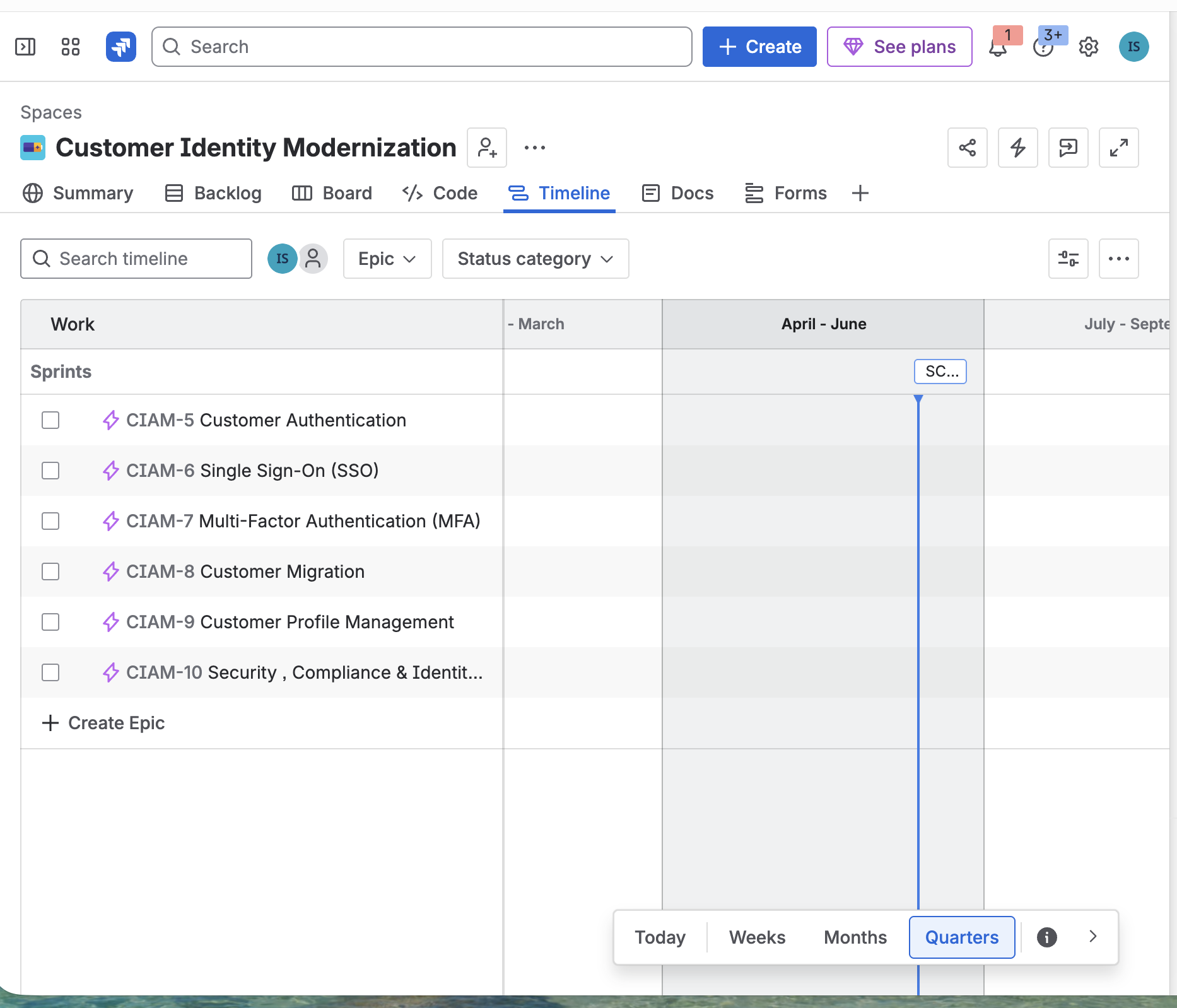
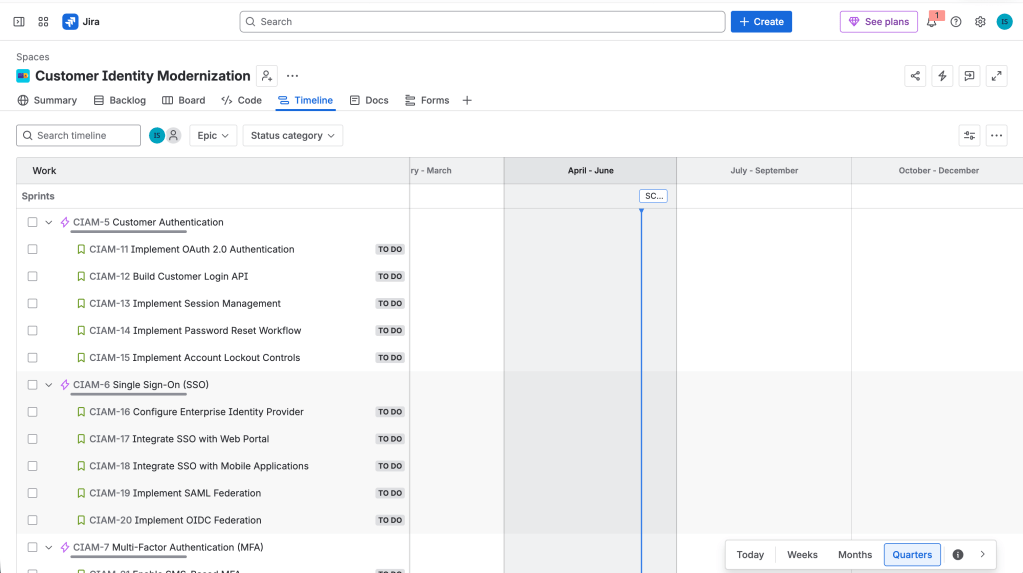
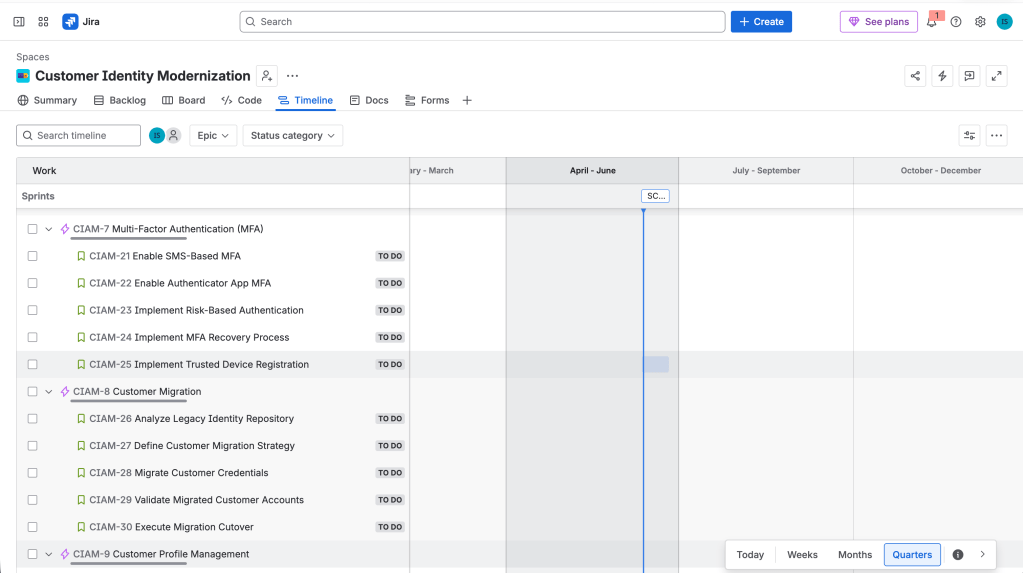
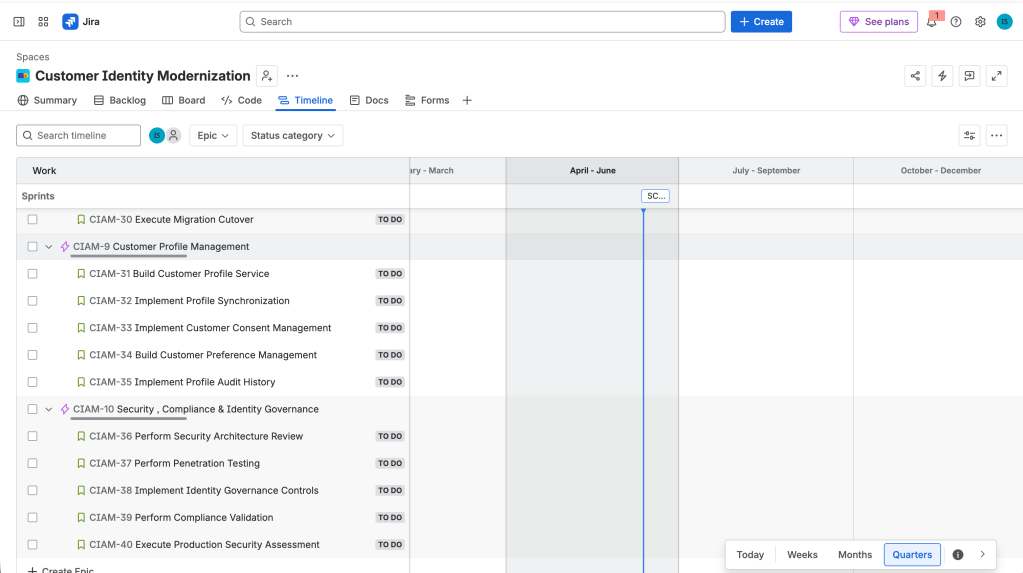
The workstreams represent business and technology capabilities that must be delivered in a coordinated manner across multiple teams.
Typical CIAM Workstreams
- Identity Platform Implementation
- Authentication and Single Sign-On (SSO)
- Multi-Factor Authentication (MFA)
- Adaptive / Risk-Based Authentication
- Customer Migration
- Customer Profile Services
- Security and Compliance
- Production Readiness and Cutover
Cross-Team Dependency Management
Managing The Critical Path
CIAM modernization programs contain significant dependencies across architecture, engineering, security, operations, customer support, and business teams.
Managing these dependencies is often one of the most important responsibilities of the Technical Program Manager.
Examples include:
Authentication → MFA
Multi-Factor Authentication capabilities depend on foundational authentication services and customer login APIs being available first.
Identity Provider → SSO
Applications cannot participate in Single Sign-On until a centralized Identity Provider has been implemented and trusted across participating systems.
Customer Migration
Migration strategy, credential migration, validation, and production cutover activities must occur in sequence to minimize customer impact and reduce deployment risk.
Security Validation
Penetration testing and security reviews must be completed before production readiness assessments and go-live approvals can occur.
Understanding and managing these dependencies enables teams to identify the critical path, proactively mitigate risks, and maintain delivery momentum.
Key Delivery Risks
Customer Migration Risk
Migrating customer identities and credentials introduces risks related to account access, authentication failures, data quality issues, and increased customer support demand.
Security Findings
Critical vulnerabilities identified during penetration testing can impact delivery timelines and production readiness.
Cross-Team Dependencies
Authentication, profile services, security controls, and application integrations often involve multiple delivery teams with competing priorities and delivery schedules.
Customer Experience Impact
Authentication changes can increase customer friction if customer journeys are not carefully designed, tested, and validated.
Production Cutover Risk
Transitioning customers to a new identity platform requires careful orchestration, monitoring, rollback planning, and executive governance.
Role Of The Technical Program Manager
The TPM’s Role In CIAM Modernization
Technical Program Managers provide the governance, structure, and execution discipline required to deliver the business benefits of a CIAM modernization program.
Their role is to align business objectives, technology delivery, security requirements, operational readiness, and customer experience outcomes.
Program Governance
Align business, security, architecture, and delivery stakeholders around business benefits, technology objectives, delivery plans, financials, risks, and milestones.
Dependency Management
Manage critical path dependencies across authentication, migration, security, profile services, and production readiness activities.
Risk Management
Identify delivery risks early and drive mitigation plans across multiple teams.
Executive Reporting
Provide clear visibility into progress, risks, milestones, financials, and readiness to senior leadership.
Release Coordination
Coordinate testing, security approvals, migration activities, production cutovers, and operational readiness activities.
Stakeholder Alignment
Ensure business, technology, security, operations, and customer-facing teams remain aligned on priorities, commitments, and delivery outcomes.
Delivering Complex Identity Modernization Programs
CIAM modernization programs sit at the intersection of customer experience, security, identity management, data management, privacy, and operational readiness.
Successful delivery depends not only on the technology platform, but also on disciplined program management, stakeholder alignment, dependency management, risk management, and execution governance.
Organizations that approach CIAM modernization as a business transformation initiative rather than solely a security project are better positioned to improve customer experience, strengthen security, achieve regulatory complaince, reduce operational complexity, and accelerate future digital growth.

